Does Insurance Cover Fence Damage? What Homeowners Should Know
Homeowners insurance may help pay for fence replacement or repair after covered fence damage, but coverage is not automatic. The cause, policy terms, deductible, depreciation, fence ownership, and insurer’s investigation affect what may be paid.
For homeowners in Oak Park, Chicago, and surrounding communities, the first priorities are safety, documentation, and understanding the damage. At Suburban Fence Inc., we help property owners understand the construction work a damaged fence may require. Our fence repair and replacement services page provides details about our fencing work.
This article provides general information and is not insurance or legal advice. Coverage decisions are made by the insurer under the specific policy and facts of the loss.
Table of Contents
Does Homeowners Insurance Cover a Damaged Fence?
Homeowners insurance may include coverage for detached structures, including fences. The National Association of Insurance Commissioners identifies fences as examples of property that may fall under other-structures coverage.
That does not mean every damaged fence qualifies for payment. The insurer considers the policy, the reported cause, applicable exclusions, and other circumstances.
Which Insurance Terms Should Homeowners Know?
Several terms can help you ask better questions when discussing a claim:
- Other-structures coverage: The portion of a policy that may apply to qualifying detached structures, including fences.
- Coverage limit: The maximum amount payable under the applicable policy provision, subject to its terms.
- Deductible: The amount the homeowner is generally responsible for under the applicable policy terms.
- Actual cash value: A valuation approach that generally accounts for depreciation.
- Replacement cost: A valuation approach based on eligible repair or replacement costs, subject to the policy’s conditions.
- Exclusion: A policy provision identifying circumstances or losses that are not covered.
- Endorsement: A modification to a policy that may add, remove, or change coverage.
- Mitigation: Reasonable measures taken to limit additional damage after a loss, such as securing an unsafe area or arranging temporary protection.
Mitigation requirements and reimbursement for temporary measures vary by policy. Keep receipts and ask your insurer what documentation it needs.
The NAIC’s explanation of actual cash value and replacement cost provides additional background. Your insurer should explain which provisions apply specifically to your fence.
Why Does the Cause of Damage Matter?
The cause of a fence failure can affect how an insurer evaluates a claim. Sudden impact damage may raise different questions from deterioration that developed over several seasons.
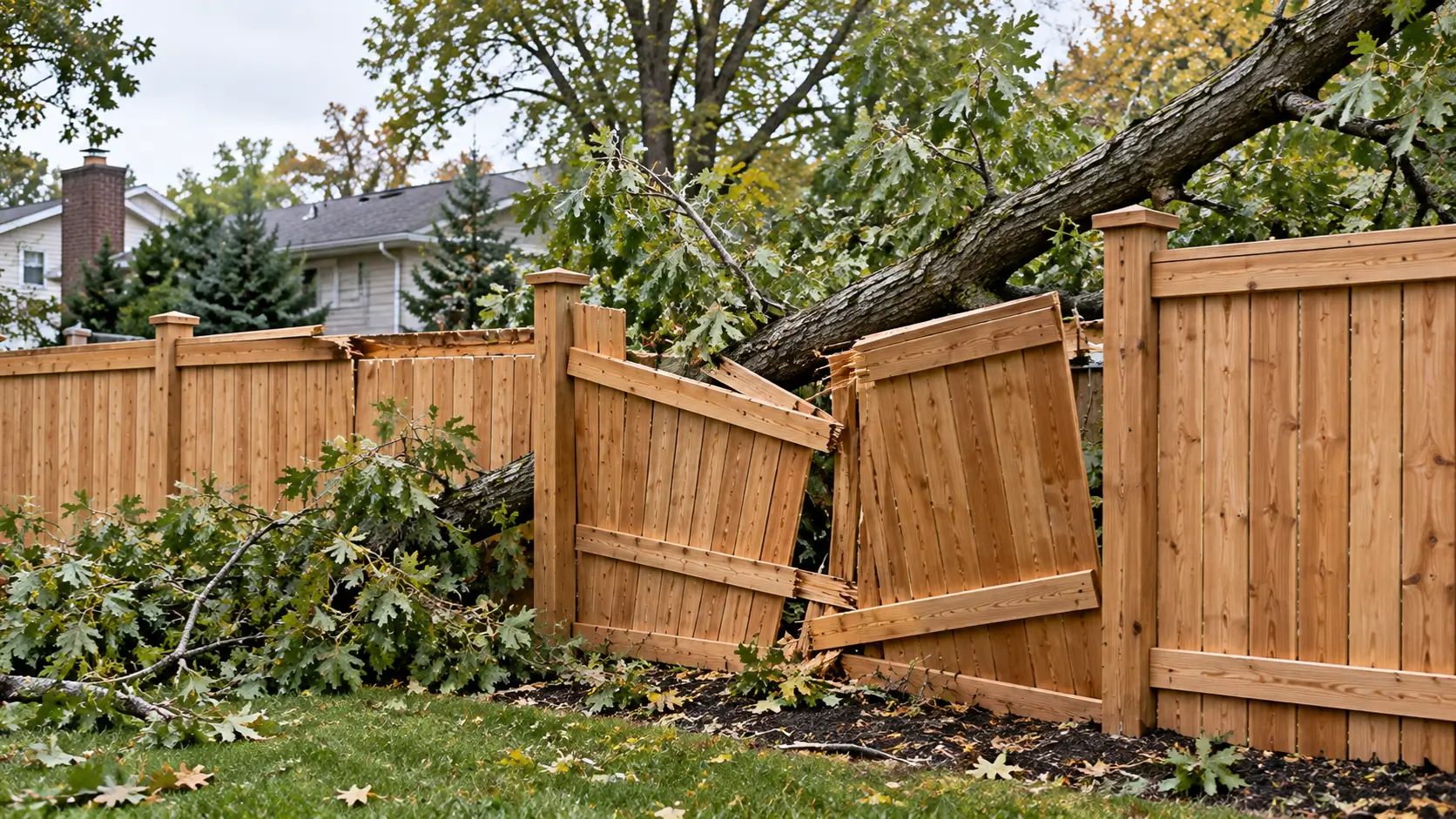
A fallen branch, for example, may break sound fence panels. It may also expose posts that were already weakened by moisture. Those construction conditions matter when determining what work is practical, but the insurer decides how the policy applies.
Ten Fence Damage Scenarios: Questions and Evidence
| Possible Cause | Homeowner's Coverage Question | Evidence to Preserve |
|---|---|---|
| Strong Wind | Does my policy cover this wind-related loss? | Broken sections, photographs, weather details |
| Hail | Does the policy apply to hail damage affecting fencing? | Impact marks, dated photographs |
| Heavy Snow | How does my policy treat damage from snow weight? | Bent rails, damaged panels, snow conditions |
| Ice Accumulation | Is this type of ice-related loss included or excluded? | Displaced components, ice conditions, photographs |
| Fallen Tree or Branch | Does coverage depend on why the tree or branch fell? | Impact area, debris, photographs before cleanup |
| Vehicle Impact | Does my policy apply, and should another insurer be contacted? | Damage pattern, incident report, witness information |
| Vandalism | What reporting or evidence does my insurer require? | Damage photographs, police report if appropriate |
| Fire | Which policy provisions apply to this type of fire damage? | Incident records, photographs, affected materials |
| Rot or Corrosion | Does the policy exclude deterioration or maintenance-related damage? | Earlier photographs, maintenance history, deteriorated components |
| Ground Movement | Does my policy cover or exclude this cause of movement? | Leaning posts, soil conditions, surrounding damage |
These questions help homeowners prepare for a conversation with their insurer. The table does not predict coverage.
For weather-related incidents, the National Weather Service’s Chicago-area event records may provide useful background. Weather records alone do not establish the cause of an individual fence failure or determine storm damage insurance coverage.
What Problems Suggest Gradual Deterioration?
Rot near wood posts, corrosion at connections, repeated gate misalignment, and persistent leaning may indicate developing problems.
Maintenance records and earlier photographs can help distinguish preexisting conditions from new damage. Our fall fence weatherproofing article explains several seasonal issues homeowners should watch for.
What Should You Do After Fence Damage?
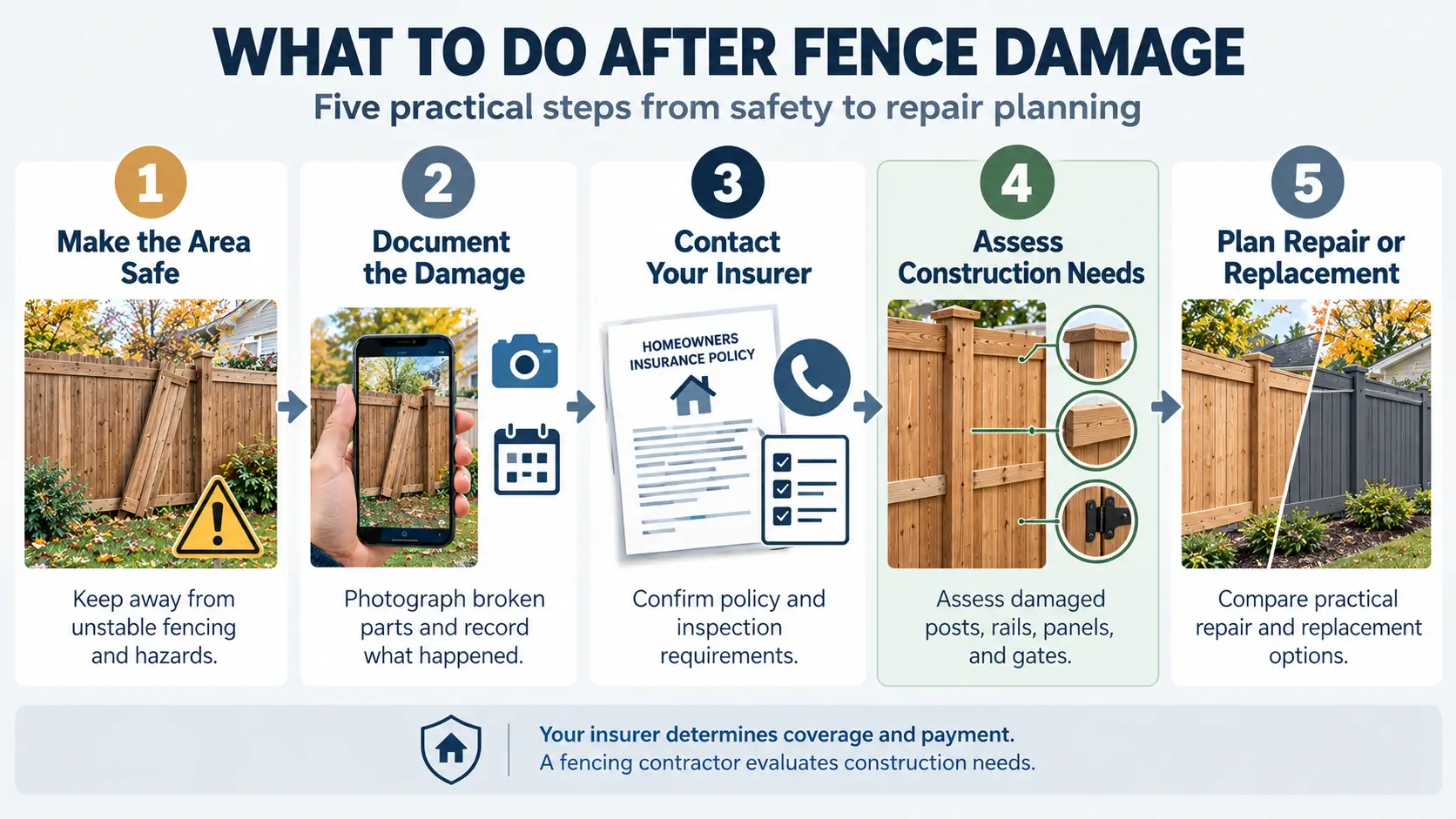
Start with safety. Damaged fencing may contain sharp hardware, unstable posts, or sections that could fall without warning. Fallen electrical wires and damaged trees require particular caution.
Fence Damage Claim Checklist
- Keep people and pets away from unstable fencing.
- Contact emergency services or utility providers when immediate hazards are present.
- Photograph the damage from a safe position.
- Record when the damage was discovered and what may have happened.
- Take reasonable steps to prevent additional damage without creating new hazards.
- Keep receipts for temporary protective measures.
- Contact your insurer to ask about reporting and inspection requirements.
- Request a written assessment of the proposed fencing work.
- Preserve relevant correspondence and records.
When safety allows, document the original condition before debris removal or permanent construction changes the scene. Ask the insurer what it needs before beginning nonemergency work.
How Should You Document the Damage?
Good documentation shows both the damaged components and their relationship to the surrounding fence.
We recommend preserving:
- Wide photographs showing the entire affected fence run.
- Close-up photographs of damaged posts, rails, panels, gates, and connections.
- Earlier photographs showing the fence’s previous condition.
- Incident details, including dates, weather conditions, and witness information.
- Measurements of affected sections and components.
- Receipts and correspondence relating to temporary work and insurer instructions.
Keep original files when possible and organize them by date. Documentation may assist with property fence claims, but the insurer determines what information is required.
Fence Damage Photo Documentation Guide
A homeowner photo guide can make documentation more consistent by identifying useful camera angles, affected components, incident details, and file-organization steps.
What Should a Contractor Estimate Include?
A fencing cost estimate should identify the work being proposed, not simply provide a total price.
Depending on the damage, useful details may include fence length, material type, affected posts, rails, panels, gates, hardware, labor, removal, disposal, site access, and construction assumptions.
A fence with two broken panels and stable posts presents a different construction problem from one with displaced posts and damaged footings.
An estimate helps explain construction needs. It does not guarantee fence repair coverage or establish what an insurer must pay.
Who Decides Coverage and Construction Needs?
Your insurer or claims adjuster evaluates the claim, interprets the applicable policy, and determines coverage and payment.
A fencing contractor assesses the physical condition of the fence and proposes practical construction work. At Suburban Fence, we can explain how damaged posts, rails, panels, and gates affect repair and replacement options without representing ourselves as insurance adjusters.
Other professionals may become involved when necessary. A property surveyor can identify boundaries, a tree professional can assess tree hazards, an attorney can advise on legal responsibility, and the municipality can explain applicable permit requirements.
Will Insurance Pay for Repair or Fence Replacement?
A construction recommendation and an insurance settlement are not the same thing.
The appropriate work depends on the affected components, the condition of adjoining sections, the fence material, and whether compatible replacement parts are available.
When Is a Smaller Repair Practical?
A limited repair may be practical when damage is confined to a panel, rail, or gate component and the surrounding supports remain sound.
For example, replacing an isolated broken wood panel may be reasonable if its posts and adjacent sections are stable.
When Might Partial Replacement Be Needed?
Partial replacement may make sense when several connected sections are damaged or when a failed post affects neighboring panels.
Matching older materials can complicate the work. Color changes, discontinued profiles, weathering, and connection differences may affect the appearance or practicality of a partial rebuild.
When Should Full Replacement Be Considered?
Full fence replacement may be worth evaluating when widespread post instability, extensive material deterioration, or damage across much of the fence line makes smaller work impractical.
Wood, vinyl, chain-link, aluminum, and steel systems have different construction characteristics. We consider how their components work together rather than assuming the same solution applies to every fence.
Homeowners planning work around seasonal conditions can also review our fence replacement before winter guidance.
The insurer determines whether any proposed repair or replacement cost qualifies for payment under the policy.
How Do Deductibles and Depreciation Affect Payment?
The amount needed for construction may differ from the amount an insurer determines is payable.
Policy limits, deductibles, valuation provisions, exclusions, and the approved scope of work can affect the outcome.
How Does the Deductible Work?
The deductible is the amount the homeowner is generally responsible for under the applicable policy terms. Depending on the covered loss and deductible, the insurer may issue a reduced payment or no payment.
Before deciding whether to submit a claim, review the applicable deductible and discuss the documented damage and claim requirements with your insurer.
How Do Actual Cash Value and Replacement Cost Differ?
Actual cash value generally reflects depreciation based on age, condition, and wear.
Replacement-cost provisions may provide payment based on eligible repair or replacement expenses without the same depreciation deduction, subject to policy terms, limits, and any required documentation or completion conditions.
The NAIC explains the distinction between these valuation approaches. Ask your insurer which valuation method applies to the damaged fence and whether additional payment is conditional on completed work.
Why Might an Estimate Differ From the Insurer's Payment?
A contractor’s estimate describes proposed construction costs. An insurer separately evaluates which expenses qualify under the policy.
Differences may involve the approved work scope, depreciation, deductibles, coverage limits, or exclusions.
Homeowners should ask for an explanation of the insurer’s determination rather than assuming the construction estimate and claim payment will match.
What About Trees, Neighbors, and Vehicles?
Fence damage involving another property or person can raise questions beyond construction.
A neighbor’s fallen tree does not automatically establish legal responsibility. The circumstances, property ownership, applicable law, and insurance terms matter.
A vehicle impact may involve another party’s insurer. A shared fence may require clarification of property boundaries or ownership before work proceeds.
Our neighbor fence dispute guidance discusses why it is useful to separate property-line questions from construction decisions.
For legal responsibility, consult an appropriate legal professional. For coverage, contact the insurer.
How Suburban Fence Helps Homeowners
Suburban Fence Inc. is a family-owned fencing company serving Chicagoland since 1977.
We work with residential and commercial fencing materials, including wood, vinyl, chain-link, aluminum, and steel. Each material has different installation details, connections, maintenance needs, and construction considerations.
When evaluating a damaged fence, we focus on questions such as whether the posts remain stable, whether adjoining sections are affected, and whether repair or rebuilding is practical.
Our role is to help homeowners understand their fencing options—not to promise insurance approval or determine legal responsibility.
Fence Damage Insurance FAQs
Common questions about fence damage, insurance coverage, and claims.
Does homeowners insurance cover wind damage to a fence?
Answer: It may, depending on the policy, the cause of the damage, exclusions, and the insurer's findings.
Does a storm make an already deteriorated fence covered?
Answer: Not automatically. The insurer may consider whether existing deterioration contributed to the failure.
Will insurance pay to replace the entire fence?
Answer: Not necessarily. A policy may apply only to certain damage or eligible work, even when broader construction is being considered.
Can emergency safety work begin before an insurance inspection?
Answer: Address immediate hazards. Document conditions when safe and ask the insurer about requirements for temporary and permanent work.
Who pays if a neighbor's tree damages my fence?
Answer: Responsibility depends on the circumstances, applicable law, and relevant insurance arrangements.
Can a fencing contractor approve my claim?
Answer: No. The contractor evaluates construction needs. The insurer determines coverage and payment.
Should I get a fence estimate before contacting my insurer?
Answer: Ask your insurer about its reporting and inspection requirements. A written construction estimate can help describe the proposed work, but it does not replace the insurer's review.
Plan Your Fence Repair or Replacement
After fence damage, clear photographs, accurate records, and a practical construction assessment help homeowners make informed decisions.
If your fence needs attention in Oak Park, Chicago, or the surrounding area, contact Suburban Fence Inc. to discuss your project.
Get a Fence Estimate →SUBURBAN FENCE INC. | OAK PARK • CHICAGO • SURROUNDING AREAS